Past launch
Launched successfully
GOSAT-GW (Ibuki GW)
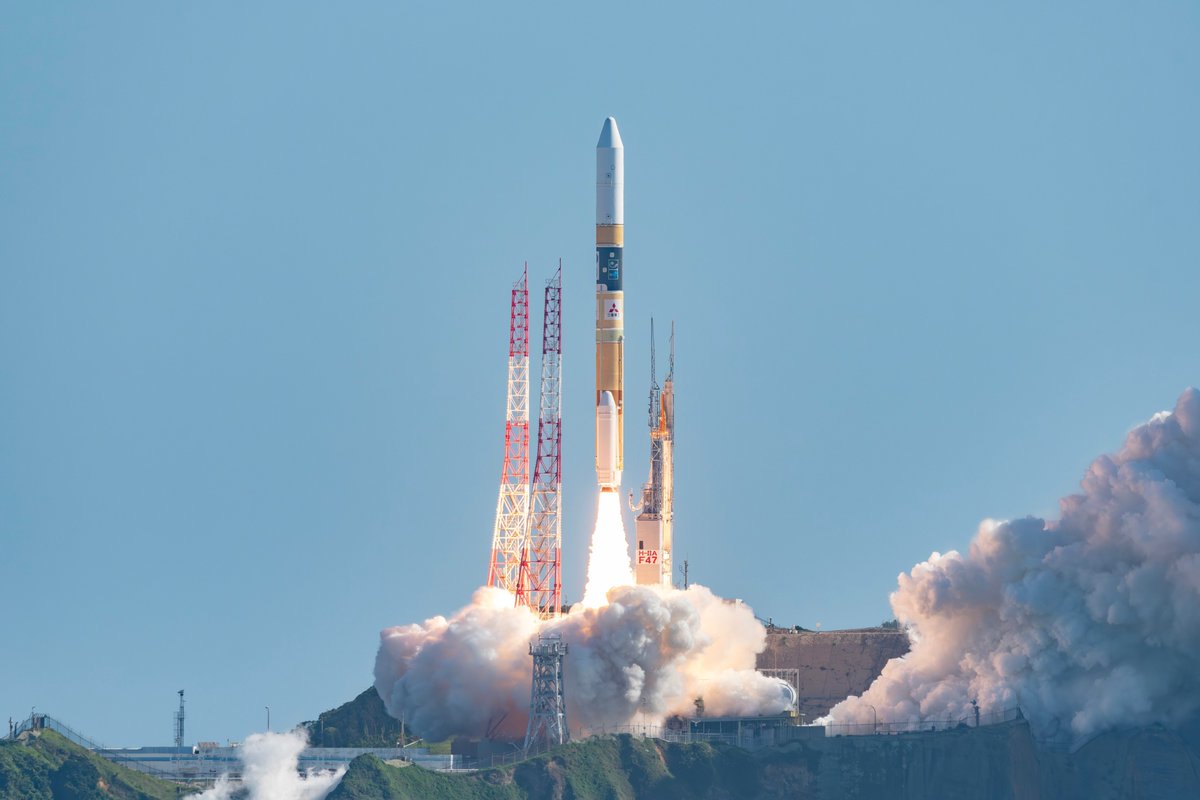
H-IIA 202, flown by Japan Aerospace Exploration Agency
Launches / H-IIA 202
H-IIA 202, flown by Japan Aerospace Exploration Agency
This was Japan Aerospace Exploration Agency's 1st launch of 2025, and its 37th in all.
Counting every operator, it was the 145th orbital launch attempt anywhere in 2025, and the first from Yoshinobu Launch Complex LP-1.
 Japan Aerospace Exploration Agency
GOSAT-GW (Greenhouse Gases Observing Satellite Greenhouse gases and Water cycle), also known as Ibuki GW and formerly known as GOSAT 3, is JAXA's next generation satellite to monitor the greenhosue gases like carbon dioxide in the Earth's atmosphere. It is the follow on to the GOSAT 2 (Ibuki 2) and GCOM-W (Shizuku) missions. GOSAT-GW will have two missions: greenhouse gases observation for Japan's Ministry of the Environment and the National Institute for Environmental Studies (NIES), and water-cycle observation for JAXA. By developing the GOSAT-GW satellite, Mitsubishi Electric will contribute to measures for preventing disasters attributed to global warming and climate change, and to advance scientific and technological methods that enable more accurate prediction of climate change. In December 2013, Mitsubishi Electric (MELCO) was selected as the prime contractor for the spacecraft and the instruments.
H-IIA (H2A) is an active expendable launch system operated by Mitsubishi Heavy Industries (MHI) for the Japan Aerospace Exploration Agency. The liquid-fueled H-IIA rockets have been used to launch satellites into geostationary orbit, to launch a lunar orbiting spacecraft, and to launch Akatsuki, which studied the planet Venus. Launches occur at the Tanegashima Space Center.
35 flights, 35 of them successful.
Japan Aerospace Exploration Agency
The Japan Aerospace Exploration Agency (JAXA) is Japan's national aero-space agency. Through the merger of three previously independent organizations, JAXA was formed on 1 October 2003. JAXA is responsible for research, technology development and the launch of satellites into orbit, and is involved in many more advanced missions, such as asteroid exploration and possible manned exploration of the Moon. JAXA launch their Epsilon vehicle from the Uchinoura Space Center and their H-II vehicles from the Tanegashima Space Center.
37 launches so far, 33 of them successful. The last 2 in a row went to plan.
It went up from Yoshinobu Launch Complex LP-1 at Tanegashima Space Center, Japan.
This one is done, but there is another along shortly. Flyby works out whether it climbs into your sky, and wakes you in time to get outside.
Get Flyby free