!DOCTYPE html> Upcoming Rocket Launches — Live Countdown · Flyby

Every upcoming rocket launch.

Know when they're happening, and never miss the next one. There are more of them than you'd think, and most people miss them. We would rather you went outside.

What's launching next

Mission

Synthetic aperture radar satellite for Japanese Earth imaging company Synspective.

Earth science · Low Earth orbit

Launch site

Rocket Lab Launch Complex 1, Mahia Peninsula, New Zealand

Launch provider

Rocket Lab

93 launches · 89 successful · 52 consecutive

Mission

A batch of 27 satellites for the Starlink mega-constellation - SpaceX's project for space-based Internet communication system.

Communications · Low Earth orbit

Launch window

Wednesday, Sept. 2, 2026, 7:46 to 11:46 a.m. UTC

Launch site

Vandenberg SFB, CA, USA

Space Launch Complex 4E

Launch provider

SpaceX

724 launches · 709 successful · 209 consecutive

Mission

GISAT-1A (GEO Imaging Satellite) is an Indian earth observing satellite operating from geostationary orbit to facilitate continuous observation of Indian sub-continent, quick monitoring of natural hazards and disaster. EOS-05/GISAT-1A will replace EOS-03/GISAT-1 lost in launch failure in 2021.

Earth science · Geostationary transfer orbit

Launch window

Thursday, Sept. 3, 2026, 9:00 p.m. to Friday, Sept. 4, 2026, 1:00 a.m. UTC

Launch site

Satish Dhawan Space Centre, India

Satish Dhawan Space Centre Second Launch Pad

Launch provider

Indian Space Research Organization

99 launches · 84 successful

Mission

A batch of 27 satellites for the Starlink mega-constellation - SpaceX's project for space-based Internet communication system.

Communications · Low Earth orbit

Launch window

Sunday, Sept. 6, 2026, 10:59 a.m. to 2:59 p.m. UTC

Launch site

Vandenberg SFB, CA, USA

Space Launch Complex 4E

Launch provider

SpaceX

724 launches · 709 successful · 209 consecutive

All upcoming launches →

Will you see the next launch from home?

The answer might surprise you.

Rockets out of Florida are routinely visible from as far north as the DC, New York and Boston corridor. In pre-dawn twilight, most of the Eastern Seaboard can see them.

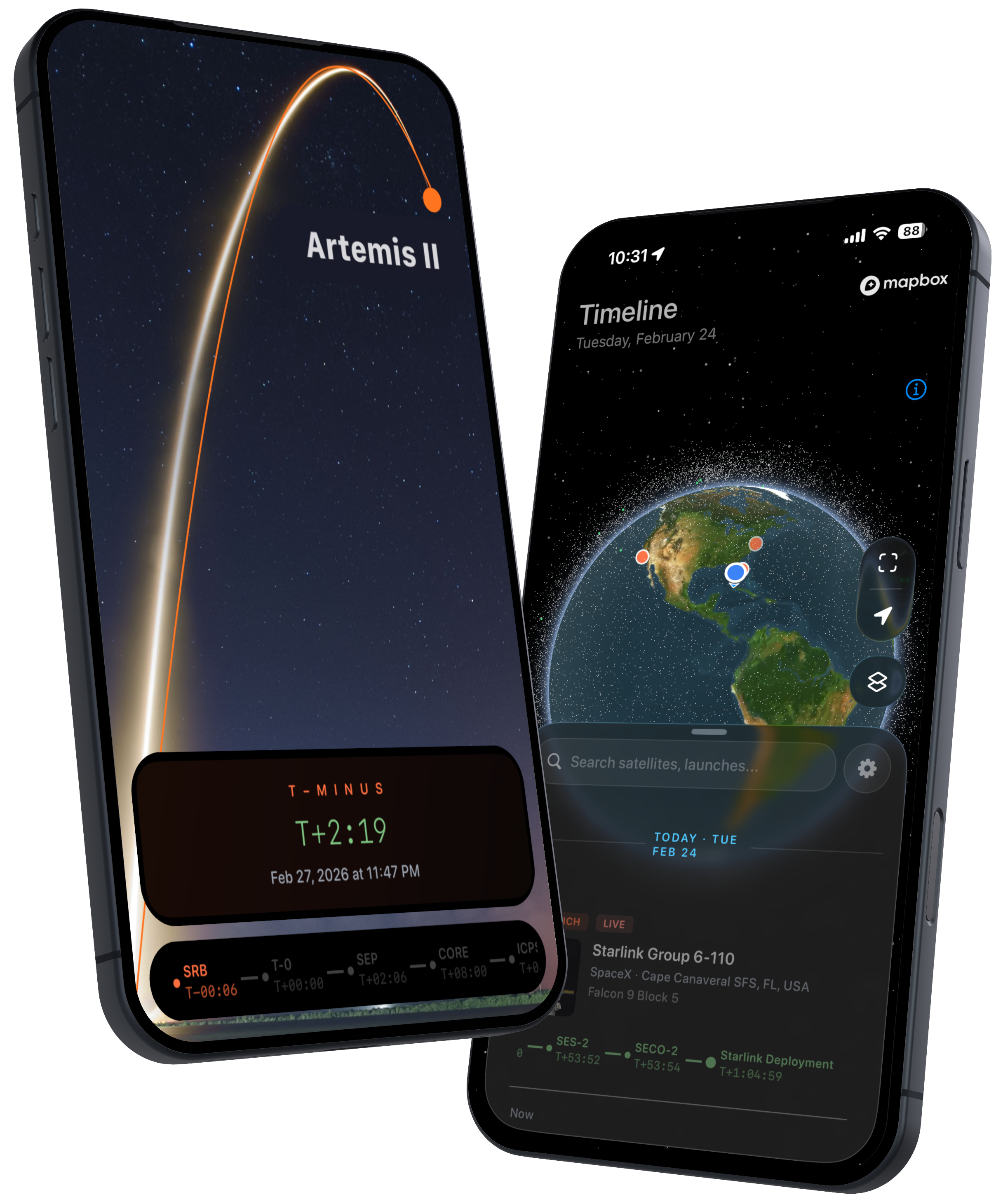
Flyby works out whether you'll see the next one from where you live. It takes the rocket's trajectory and launch direction, how high it climbs by the time it crosses your horizon, whether the plume is still catching sunlight, and the cloud cover over you. You get a straight yes or no, and the minute to step outside.

Right before liftoff, hold your phone up. Flyby marks the spot in your sky with AR, so you're facing the right way when it climbs.

All of it is in Flyby now.

Get Flyby free
Free on iPhone & iPad. Pro is $39.99/year or $9.99/month. Read the introduction.

Flyby app showing Artemis II launch trajectory and 3D globe timeline