Past launch
Launched successfully
Ionosfera-M 3 & 4
Soyuz 2.1b/Fregat-M, flown by Russian Federal Space Agency (ROSCOSMOS)
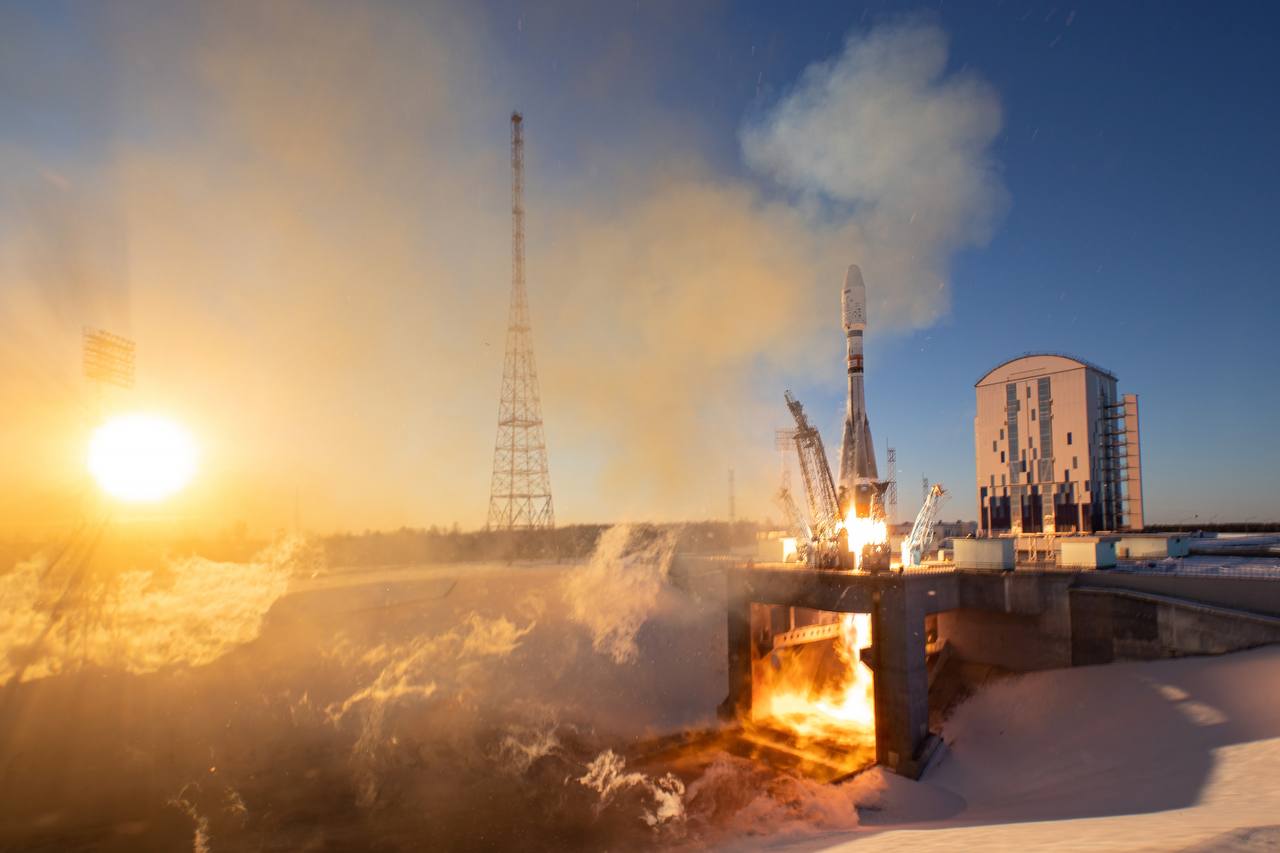
Launches / Soyuz 2.1b/Fregat-M
Soyuz 2.1b/Fregat-M, flown by Russian Federal Space Agency (ROSCOSMOS)
This was Russian Federal Space Agency (ROSCOSMOS)'s 4th launch of 2025, and its 333rd in all.
Counting every operator, it was the 159th orbital launch attempt anywhere in 2025, and the first from Cosmodrome Site 1S.
 Russian Federal Space Agency (ROSCOSMOS)
Ionosfera is a constellation of four ionospheric and magnetospheric research satellites developed by for Roscosmos for the project Ionozond. The satellites will operate on circular sun-synchronous orbits (SSO), at altitude of about 800 km and located in two orbital planes of two satellites each. The following science instruments are carried on the satellites: * SPER/1 Plasma and energy radiation spectrometer * SG/1 Gamma-ray spectrometer * GALS/1 Galactic cosmic ray spectrometer / 1 * LAERTES On-board Ionosonde * NBK/2 Low-frequency wave complex * ESEP Ionospheric plasma energy spectrometer * Ozonometer-TM Ozonometer * MayaK On-board radio transmitters * PES GPS-GLONASS device
Soyuz-2, GRAU index 14A14, is the collective designation for the 21st-century version of the Russian Soyuz rocket. In its basic form, it is a three-stage carrier rocket for placing payloads into low Earth orbit. The first-stage boosters and two core stages feature uprated engines with improved injection systems, compared to the previous versions of the Soyuz. Digital flight control and telemetry systems allow the rocket to be launched from a fixed launch platform, whereas the launch platforms for earlier Soyuz rockets had to be rotated as the rocket could not perform a roll to change its heading in flight.
Russian Federal Space Agency (ROSCOSMOS)
The Roscosmos State Corporation for Space Activities, commonly known as Roscosmos, is the governmental body responsible for the space science program of the Russian Federation and general aerospace research. Soyuz has many launch locations the Russian sites are Baikonur, Plesetsk and Vostochny however Ariane also purchases the vehicle and launches it from French Guiana.
343 launches so far, 332 of them successful. The last 67 in a row went to plan.
It went up from Cosmodrome Site 1S at Vostochny Cosmodrome, Siberia, Russia.
This one is done, but there is another along shortly. Flyby works out whether it climbs into your sky, and wakes you in time to get outside.
Get Flyby free