Past launch
Launched successfully
Biomass
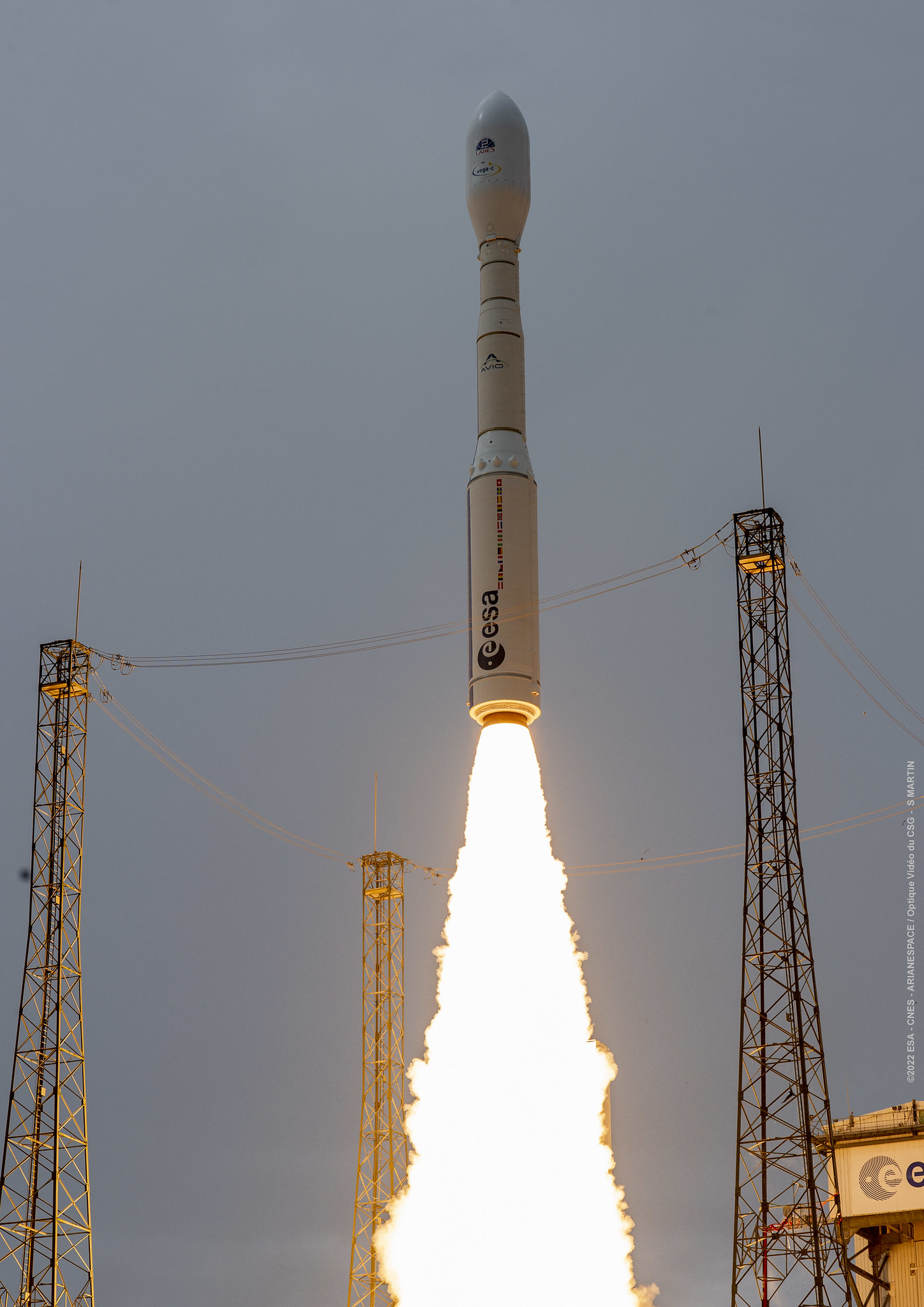
Vega-C, flown by Arianespace
Launches / Vega-C
Vega-C, flown by Arianespace
This was Arianespace's 2nd launch of 2025, and its 319th in all.
Counting every operator, it was the 92nd orbital launch attempt anywhere in 2025, and the first from Ariane Launch Area 1 (ELV).
 Arianespace
Biomass is an European Space Agency mission designed to measure the density of carbon stored in the world's forests. The spacecraft, built by Airbus Defence and Space, features the first civilian P-band synthetic aperture radar as well as a 12m-diameter deployable reflector from L3Harris made of over 900 km of gold-coated molybdenum 25µm wire. With a minimum operational lifetime of 5 years in its 666km 6am/6pm sun-synchronous orbit, the global coverage achieved every 9 months allows to precisely monitor the evolution of forests over time.
Vega-C is a single-body rocket nearly 35 m high with that weighs 210 tonnes on the launch pad. As with Vega, its main elements are three solid-propellant stages, an upper stage powered by a reignitable liquid-propellant engine and a payload fairing. Vega-C's P120C first stage replaces Vega’s smaller P80 to provide a significant increase in thrust at liftoff. It is also used as boosters (2 or 4) for the Ariane 6 rocket.
Arianespace SA is a multinational company founded in 1980 as the world's first commercial launch service provider. It undertakes the production, operation, and marketing of the Ariane programme. Their vehicles launch exclusively from French Guiana in South America.
328 launches so far, 313 of them successful. The last 16 in a row went to plan.
It went up from Ariane Launch Area 1 (ELV) at Guiana Space Centre, French Guiana.
This one is done, but there is another along shortly. Flyby works out whether it climbs into your sky, and wakes you in time to get outside.
Get Flyby free