Past launch
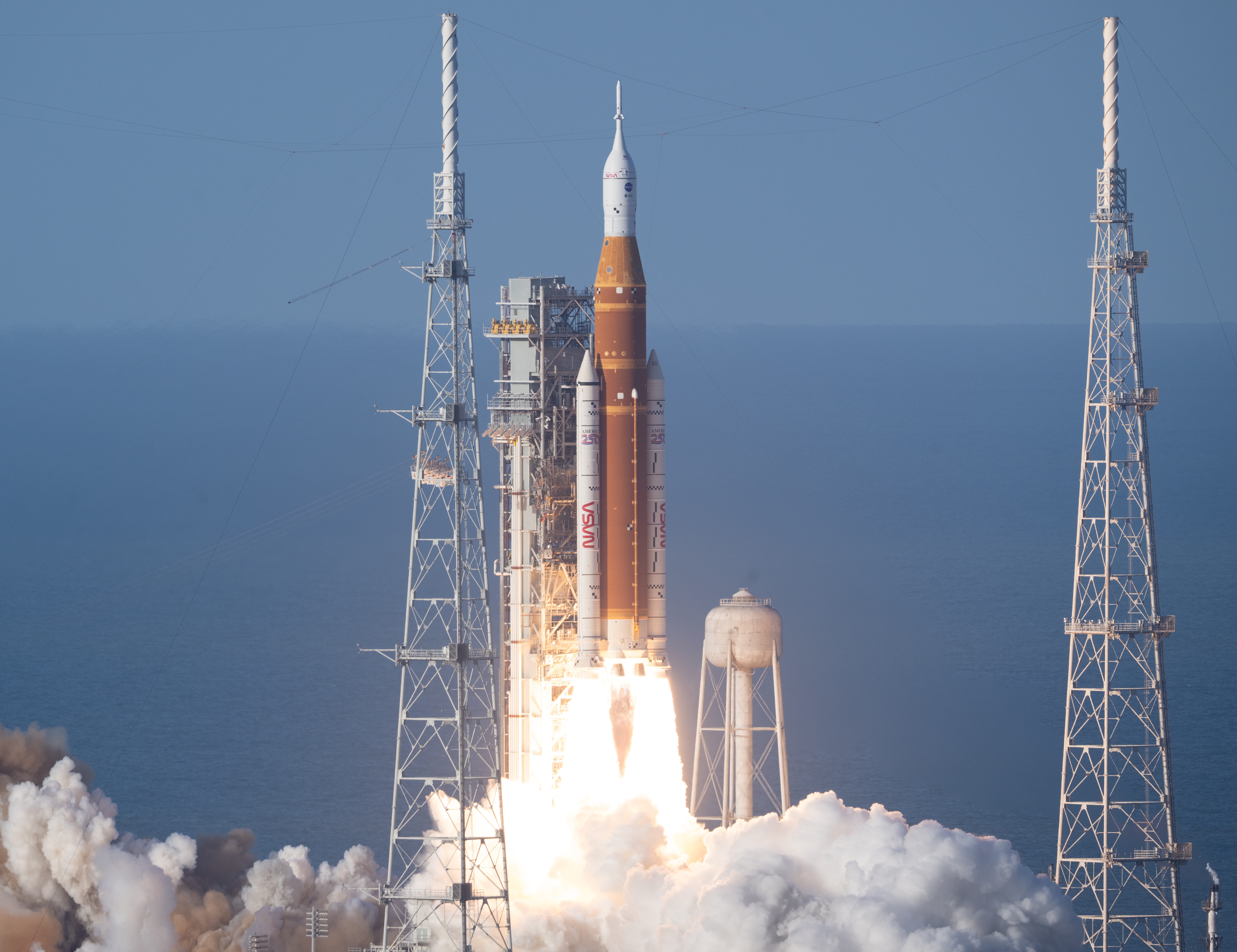
Launched successfully
Artemis II
SLS Block 1, flown by National Aeronautics and Space Administration
Launches / SLS Block 1
SLS Block 1, flown by National Aeronautics and Space Administration
This was National Aeronautics and Space Administration's 1st launch of 2026, and its 142nd in all.
Counting every operator, it was the 73rd orbital launch attempt anywhere in 2026, and the first from Launch Complex 39B.
 National Aeronautics and Space Administration
Artemis II is the first crewed mission as part of the Artemis program. Artemis II will send a crew of 4 - 3 Americans and 1 Canadian around the moon and return them back to Earth. The mission will test the core systems of NASA's Orion spacecraft including the critical life support system, among other systems which could not be tested during Artemis I due to the lack of crew onboard.
The Artemis program is a US government-funded crewed spaceflight program that has the goal of landing "the first woman and the next man" on the Moon, specifically at the lunar south pole region.
The Space Launch System (SLS) is an American Space Shuttle-derived heavy expendable launch vehicle. It is part of NASA's deep space exploration plans including as the main launch vehicle of the Artemis program. SLS follows the cancellation of the Constellation program, and is to replace the retired Space Shuttle.
First stage Second stage Third stage Side booster
Simulated from the published flight plan. The climb flattens as the rocket pitches over to build sideways speed, which is why a launch stays visible so far from the pad. A dashed line is a stage that separates and flies back down, either to the pad or to a ship waiting downrange.
Going to watch it in person? Flyby's Pathfinder points your camera at the pad, so you are not stood there guessing which one it goes up from. It puts this same climb on a globe you can turn, too.
National Aeronautics and Space Administration
The National Aeronautics and Space Administration is an independent agency of the executive branch of the United States federal government responsible for the civilian space program, as well as aeronautics and aerospace research. NASA have many launch facilities but most are inactive. The most commonly used pad will be LC-39B at Kennedy Space Center in Florida.
142 launches so far, 122 of them successful. The last 12 in a row went to plan.
It went up from Launch Complex 39B at Kennedy Space Center, FL, USA.
This one is done, but there is another along shortly. Flyby works out whether it climbs into your sky, and wakes you in time to get outside.
Get Flyby free